How Gate Access Control Systems Work in Jacksonville’s Flood-Prone Climate
A gate access control system is an electronic command center that reads an entry credential — keypad code, remote fob, smartphone app, or vehicle loop detector — then sends a low-voltage signal to a gate operator motor to open, while logging the event and managing safety sensors that prevent the gate from closing on a vehicle or person. In Jacksonville, these systems face accelerated failure from salt air corrosion, high water table moisture intrusion, and recurring storm flooding that submerges control boards in master-planned communities across the Southside and Westside corridors. If your gate is responding intermittently or not at all, call Empire Gate Repair Service Jacksonville at (877) 369-3953 — Mark Thompson diagnoses the full signal path, not just the obvious symptom.
What Jacksonville Property Managers Should Know About Access Control Components
We’ve spent twenty years tracing failures from the credential reader all the way to the motor gearbox in communities from Oakleaf Plantation to Deerwood, and the pattern is consistent: most “gate won’t open” calls aren’t motor failures — they’re breakdowns in the control system’s communication chain. Here’s how the components actually interact, and where Jacksonville’s environment attacks each one.
The Credential Reader: Where the Command Starts
The reader is whatever device accepts your entry request — a vandal-resistant keypad, a proximity card reader, a telephone entry system for visitors, or a loop detector embedded in the pavement that senses a vehicle’s metal mass. That reader translates a physical action into an electronic signal, typically 12-24 volts DC or a dry contact closure, and sends it to the control board.
In Jacksonville’s climate, readers fail predictably:
- Keypad buttons crack from UV exposure after 8-12 years of Florida sun, letting moisture into the membrane
- Proximity readers in Ortega and Murray Hill corrode at their mounting points because pre-2000s wrought-iron gates lacked proper grounding, accelerating galvanic corrosion
- Loop detector wiring in Mandarin and Baymeadows wicks groundwater year-round through conduit joints — we’ve pulled out harnesses where every copper strand was green with oxidation
Mark Thompson shows up — the owner is the technician — and we test the reader output with a multimeter before replacing anything. No guesswork.
The Control Board: The Brain That Jacksonville Floods Love to Kill
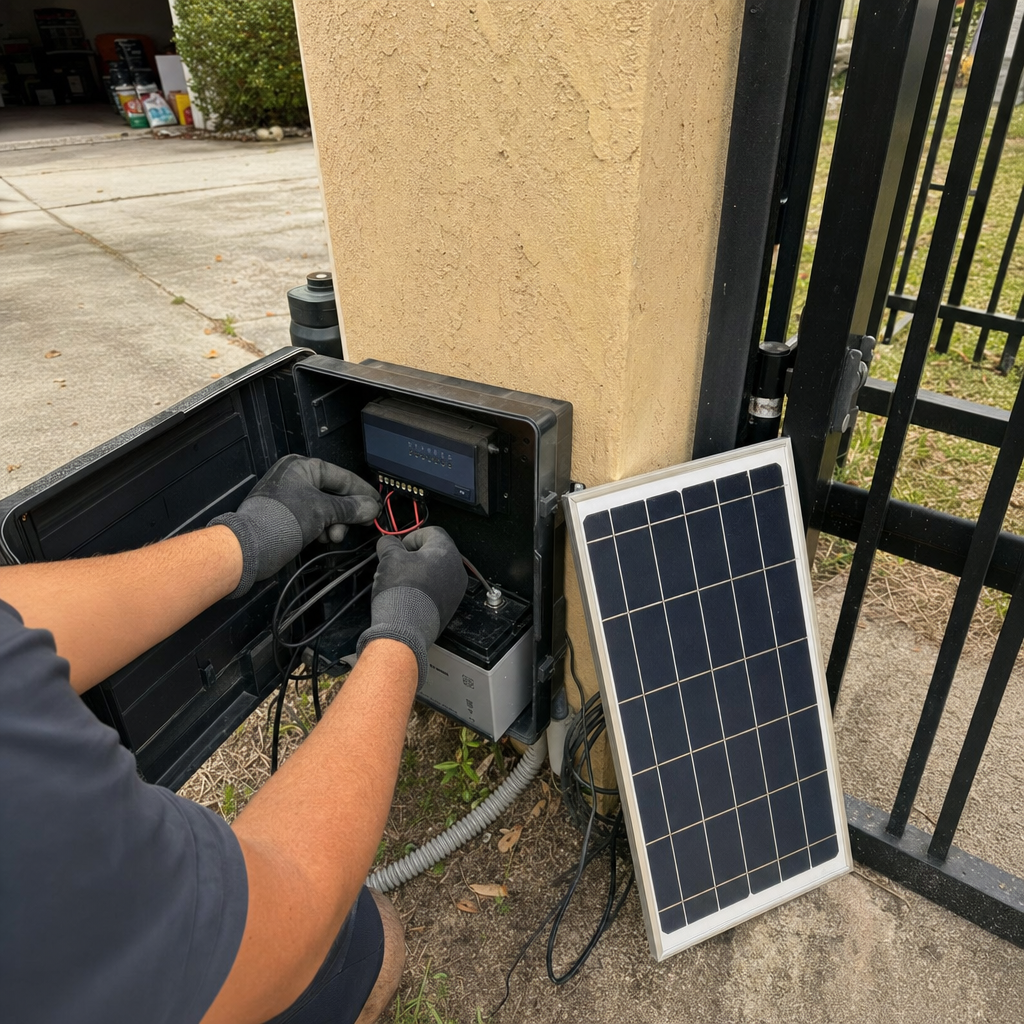
The control board receives the reader’s signal, checks it against programmed permissions, then outputs a command to the gate operator motor. Modern boards also manage entrapment protection (safety loops, photo eyes, edge sensors), timer functions, and diagnostic logging.
Here’s where Jacksonville’s geography becomes expensive. Our city sits on porous, sandy soil with a high water table across Duval County. When a tropical system drops six inches in six hours — common from May through October — water doesn’t just run off; it saturates the ground and rises into pedestal-mounted control enclosures that sit at grade level. We’ve replaced control boards in Bartram Park, Oakleaf, and Southside corridor communities where the enclosure had three inches of standing water inside. The board doesn’t always fail immediately; sometimes it corrodes slowly, causing phantom openings, ignored remotes, or gates that reverse for no apparent reason.
We work on virtually every major gate brand, including yours — LiftMaster, Viking, Linear, FAAC, BFT and others — and each manufacturer’s board has distinct diagnostic LED patterns we read to isolate whether the problem is input (reader), logic (board), or output (motor/safety circuit). Two decades of gate repairs means we’ve already solved your problem before.
The Operator Motor: What Actually Moves the Gate
The motor receives its command from the control board and converts electrical energy into mechanical force — either hydraulic pressure for heavy commercial swing gates, or direct-drive gear reduction for most residential and light commercial applications. The motor doesn’t “decide” anything; it only executes what the board tells it, provided safety sensors report clear.
Jacksonville’s salt air pushes corrosion into motor housings, especially on coastal-adjacent properties in Atlantic Beach or along the Intracoastal where salt fog drifts inland. Viking and Linear operators we service from the 2000s-era installation wave often arrive with seized limit switches or degraded capacitors. When other companies stop at the motor, we fix the metal too — our in-house welding and fabrication means we can rebuild gate frames and hinge mounts that misalignment has stressed, rather than just swapping the operator and watching it fail again in eighteen months.
How to Diagnose Whether Your Problem Is Access Control or Operator Failure
Property managers in Jacksonville’s HOA communities face a specific frustration: the gate “sort of” works, which means residents call at unpredictable intervals and the board gets blamed for slow response. Here’s our field-tested sequence to separate access control issues from mechanical ones — starting with our guide to the Best Gate Access Control in Jacksonville, FL.
- Test manual release operation. Disengage the motor and move the gate by hand. If it binds, drags, or requires excessive force, the problem is mechanical — track alignment, hinge corrosion, or structural settling. We see this constantly in 15-25-year-old installations where the original concrete footing has shifted in our sandy soils.
- Bypass the access control entirely. Use the hardwired open/close button at the operator, if accessible. If the motor runs smoothly on manual command but not via keypad or remote, the failure is upstream — reader, wiring, or control board.
- Check for intermittent safety sensor trips. A misaligned photo eye or degraded loop detector can tell the control board an obstacle is present, preventing operation. In Jacksonville’s high-humidity environment, condensation inside photo eye housings causes phantom obstruction signals, especially at dawn and dusk when temperature swings are greatest.
- Read the diagnostic display or LED pattern. Most operators from the last fifteen years flash coded error sequences. We carry reference documentation for nine major brands and can translate those flashes into actionable repairs without days of trial and error.
A gate that almost works is a gate that doesn’t work — and in a community entrance, that means security staff doing manual checks, resident complaints, and liability exposure.
What Jacksonville Access Control Repairs and Upgrades Actually Cost
How Much Does Gate Access Control Cost? (2026 Price Guide) — Jacksonville, FL: pricing varies by system complexity, but after two decades of quotes across Duval County, we’ve established consistent ranges. These assume standard residential or small-commercial swing or slide gates; multi-lane community entrances with telephone entry and camera integration run higher.
| Service | Typical Range in Jacksonville |
|---|---|
| Keypad or card reader replacement (standalone) | $280 – $520 |
| Control board replacement (single operator) | $450 – $890 |
| Loop detector repair or replacement | $340 – $680 |
| Photo eye / safety sensor alignment or replacement | $180 – $340 |
| Full access control system upgrade (reader, board, wiring) | $1,400 – $3,200 |
| Emergency diagnostic call with same-day repair | $150 – $220 service call + parts |
753 customers reviewed us — read what they say about the actual work. We don’t quote over the phone for control board failures because we’ve learned that what sounds like a “bad board” often traces to moisture-compromised wiring that a parts-swap would miss. Our diagnostic fee applies to the repair if you proceed.
For a deeper look at what we install and service, see our full Gate Access Control overview.
When to Repair vs. Replace an Aging Access Control System
Jacksonville’s housing stock creates a predictable decision point. The post-1980s suburban explosion — we’re the largest land-area city in the contiguous US — produced wave after wave of HOA communities where automated gates are effectively mandatory. That installed base now skews toward 15-25-year-old Viking, LiftMaster, and Linear operators aging out simultaneously.
We recommend repair when:
- The control board failure is isolated and the motor, safety systems, and gate structure remain sound
- The reader technology still meets your security needs (basic keypad for a small residential community, for example)
- Wiring runs are intact with no evidence of widespread moisture intrusion
We recommend replacement when:
- The operator has suffered multiple board failures, indicating systemic electrical issues or repeated flood exposure
- You’re managing a community entrance and need cloud-based access logging, smartphone credentialing, or integration with visitor management systems
- The original installer used proprietary components that are now obsolete — we’ve encountered this with certain early-2000s systems where replacement parts simply don’t exist
Our Gate Access Control in Jacksonville service covers both paths — we’ll tell you honestly which makes sense for your specific gate, usage pattern, and budget.
FAQs
This almost always means the radio receiver is functional but the keypad’s output circuit or its connection to the control board has failed — we’ve replaced hundreds of keypads in Jacksonville where moisture cracked the membrane and corroded the terminal block. The remote communicates via RF directly to a receiver module, while the keypad hardwires to the board; these are separate input paths. Call (877) 369-3953 and we’ll test both signals in about ten minutes on-site — estimates are free.
Phantom openings typically cost $180–$520 to resolve, depending on whether the cause is a degraded loop detector (false vehicle detection), a control board with moisture-corroded logic circuits, or a neighbor’s remote on the same frequency — a known issue in dense HOA communities with identical original equipment. We isolate the source before quoting, because replacing a board won’t fix a wiring short. Call (877) 369-3953 for an exact quote — estimates are free.
Yes — Jacksonville’s position at the confluence of Atlantic coastal salt air and the St. Johns River system pushes corrosive fog well inland, and we’ve seen control board terminal blocks, relay contacts, and outdoor-rated enclosures fail years before their rated lifespan in interior Florida cities like Orlando. The corrosion is often invisible until the connection resistance causes voltage drop sufficient to glitch the logic. We specify marine-grade enclosures and dielectric grease on terminal connections for coastal-adjacent installations.
We prioritize community entrance failures — including Emergency Gate Access Control in Jacksonville, FL — because we understand the security and traffic flow implications; same-day response is standard for commercial and HOA properties in Jacksonville when you call before noon. Mark Thompson carries control boards, readers, and loop detector modules for nine major brands on his service vehicle, so most repairs don’t wait for parts orders. Call (877) 369-3953 — the person who answers is usually the same person who shows up with tools in hand.
Get a Straight Assessment of Your Gate Access Control System
If you’d rather have it looked at, Empire Gate Repair Service Jacksonville offers a no-pressure assessment in Jacksonville — call (877) 369-3953. We’ll trace the full signal path, explain what failed and why, and quote only the repair that actually solves it.
Written by Mark Thompson, Owner & Lead Technician at Empire Gate Repair Service Jacksonville, serving Jacksonville, FL.